
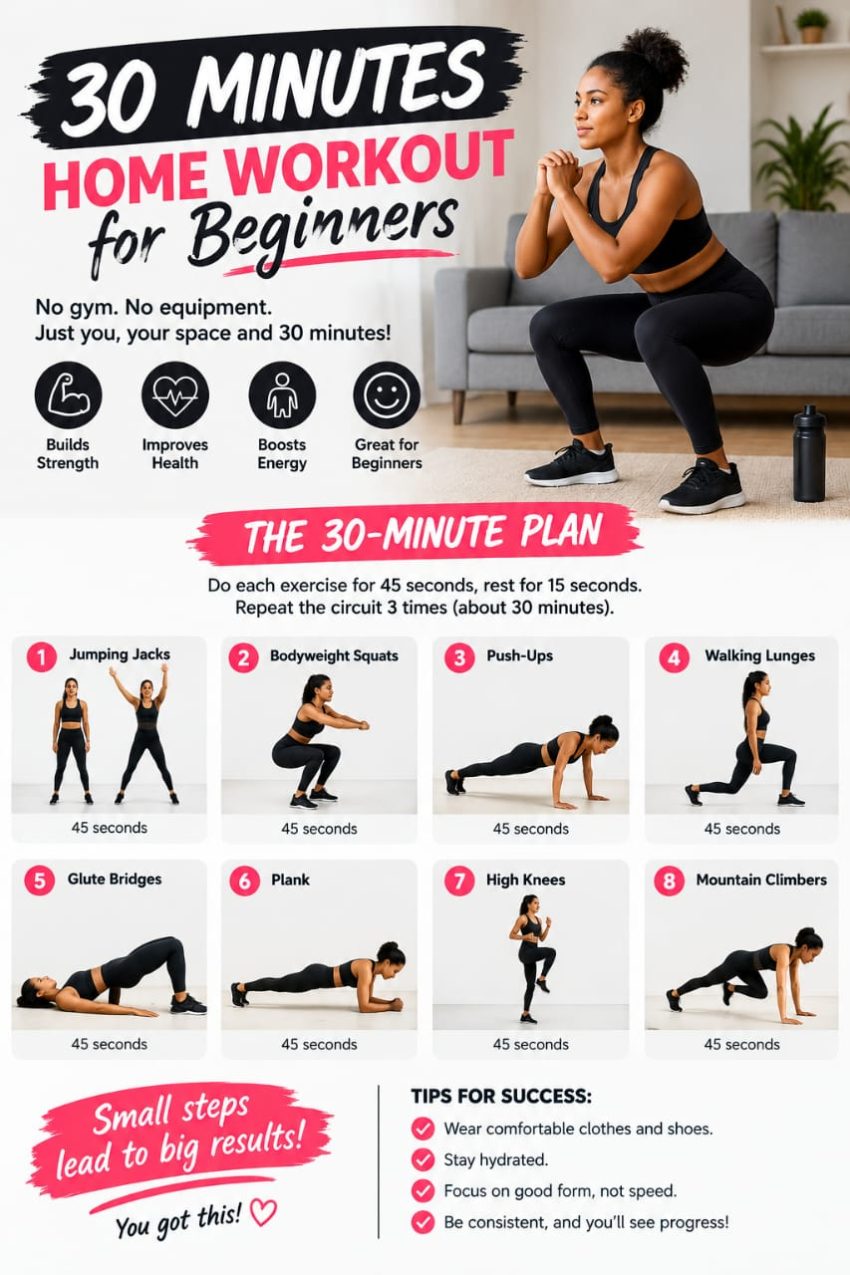
30 Minute Home Workout for Beginners: A Simple Full-Body Routine
If you are new to exercise, finding the time and motivation to work out can feel challenging. The good news is that you do not need a gym membership, expensive equipment, or hours of free time to get started. A 30 minute home workout for beginners can give you an effective way to build strength, improve fitness, burn calories, and create a consistent exercise habit.
Whether you have a busy schedule, prefer exercising privately, or simply want to start getting active from the comfort of your home, 30 minutes is enough to make a meaningful difference. The key is choosing simple exercises, using proper form, and following a routine that you can perform consistently.
This guide provides a complete beginner-friendly 30-minute home workout that targets your entire body. You will learn how to structure your workout, which exercises to perform, how long to rest, and how to progress as your fitness improves.
What Is a 30 Minute Home Workout for Beginners?
A 30 minute home workout for beginners is a short, structured exercise session designed for people who are new to fitness or returning after a long break.
The workout can include bodyweight exercises such as squats, wall push-ups, glute bridges, lunges, and planks. Because these exercises require little or no equipment, they can be performed in a bedroom, living room, garage, or other suitable space at home.
A 30-minute session can be divided into three main sections:
- 5 minutes of warm-up
- 20 minutes of full-body exercises
- 5 minutes of cool-down and stretching
This structure gives beginners enough time to prepare their bodies, exercise effectively, and gradually bring their heart rate back down.
You do not need to exercise at maximum intensity for the entire 30 minutes. Beginners should focus on learning proper movement patterns and building consistency before worrying about speed or intensity.
Benefits of a 30 Minute Home Workout
A regular home workout can provide several physical and mental benefits. You may not see dramatic changes overnight, but consistent exercise can gradually improve your fitness and overall well-being.
1. It Saves Time
One of the biggest advantages of a 30-minute workout is convenience. You do not have to drive to a gym, wait for equipment, or spend extra time getting ready.
You can simply put on comfortable workout clothes, clear a small area, and begin.
For busy people, a short workout can be much easier to maintain than a one-hour routine.
2. It Helps Build Strength
Bodyweight exercises can help beginners develop strength in the legs, chest, shoulders, arms, back, and core.
Exercises such as squats and lunges challenge your lower body, while push-ups work your chest, shoulders, and triceps. Planks and other core exercises help strengthen the muscles around your midsection.
3. It Improves Cardiovascular Fitness
Moving continuously for 20 minutes can elevate your heart rate and improve cardiovascular endurance.
You can also include low-impact movements such as marching in place, step-ups, or modified jumping jacks to add a cardio component without requiring advanced fitness skills.
4. It Can Support Weight Management
Exercise increases the amount of energy your body uses. When combined with a balanced diet and appropriate calorie intake, regular workouts can support healthy weight management.
However, the number of calories burned during a workout varies depending on factors such as body size, exercise intensity, fitness level, and workout duration.
5. It Builds a Consistent Exercise Habit
Perhaps the most important benefit for beginners is consistency.
You do not need a perfect workout. You need a routine that you can repeat.
Thirty minutes is short enough to fit into many schedules while still providing enough time for a productive session.
What You Need for This Workout
The best thing about this beginner workout is that you need very little equipment.
Ideally, you should have:
- A small amount of open floor space
- Comfortable workout clothing
- Supportive shoes if appropriate for your surface
- A workout mat or towel
- A bottle of water
- A timer
Optional equipment such as light dumbbells or resistance bands can be added later, but they are not necessary when you are just starting.
Before beginning, make sure the workout area is free from objects that could cause you to trip or fall.
The 30 Minute Home Workout for Beginners
Here is the complete routine.
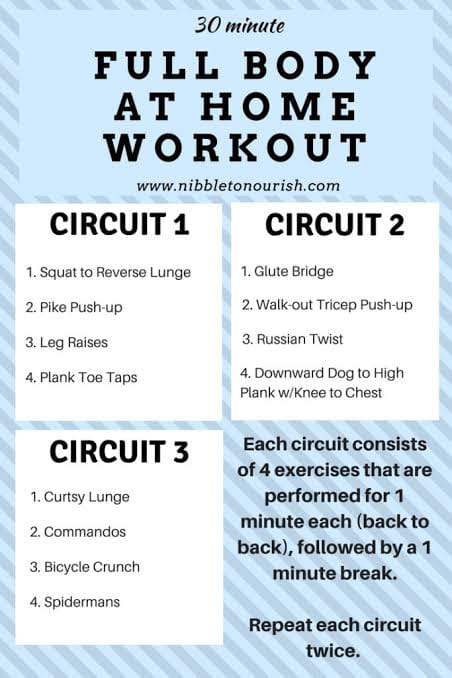
Workout Structure
Warm-up: 5 minutes
Main workout: 20 minutes
Cool-down: 5 minutes
During the main workout, perform each exercise for approximately 40 seconds and rest for 20 seconds. Complete two rounds of the exercise circuit.
If 40 seconds is too difficult, work for 20–30 seconds and rest longer. Your goal is to maintain good form rather than simply completing as many repetitions as possible.
5-Minute Warm-Up
Never underestimate the importance of warming up. A few minutes of easy movement can help prepare your body for exercise.
1. March in Place – 1 Minute
Stand upright and march gently in place.
Move your arms naturally as you lift your knees. Start slowly and gradually increase your pace.
Keep your shoulders relaxed and maintain good posture.
2. Arm Circles – 30 Seconds
Extend your arms out to the sides and make small circles.
Gradually make the circles larger, then reverse the direction.
This movement gently prepares your shoulders and upper body.
3. Bodyweight Squats – 1 Minute
Stand with your feet approximately shoulder-width apart.
Push your hips backward and bend your knees as if you are sitting in a chair. Lower yourself only as far as comfortable, then stand back up.
Keep your chest lifted and your knees tracking in the same general direction as your toes.
4. Alternating Knee Lifts – 1 Minute
Stand tall and slowly lift one knee toward your waist, then lower it and switch sides.
Use your arms to help maintain balance and rhythm.
5. Easy Step Touches – 1 Minute
Step to the right, bring your left foot toward it, then step to the left.
Continue alternating sides while gently moving your arms.
This completes your five-minute warm-up.
20-Minute Full-Body Workout
Now it is time for the main workout.
Complete the following exercises for about 40 seconds each, followed by 20 seconds of rest. Once you finish all exercises, rest for approximately one minute and repeat the circuit.
If you are completely new to exercise, start with one round and gradually build toward two rounds.
1. Bodyweight Squats
Time: 40 seconds
Squats are one of the best beginner exercises because they train several lower-body muscles at once.
Stand with your feet around shoulder-width apart. Keep your chest up and your core gently engaged.
Push your hips backward and bend your knees. Lower your body as far as you can comfortably while maintaining good form.
Press through your feet to return to the standing position.
Beginner modification: Use a chair behind you. Slowly lower yourself toward the chair and stand back up without dropping heavily into the seat.
2. Wall Push-Ups
Time: 40 seconds
Traditional push-ups can be difficult for beginners, so wall push-ups are a great place to start.
Stand facing a wall and place your hands against it around chest height.
Take a small step backward. Bend your elbows and slowly bring your chest toward the wall.
Push through your hands to return to the starting position.
Keep your body relatively straight throughout the movement.
As you become stronger, you can progress to incline push-ups using a sturdy elevated surface and eventually regular floor push-ups.
3. Glute Bridges
Time: 40 seconds
Glute bridges target the muscles of your hips and buttocks while also challenging your core.
Lie on your back with your knees bent and your feet flat on the floor.
Keep your arms beside your body. Tighten your core and squeeze your glutes as you lift your hips toward the ceiling.
Pause briefly at the top, then slowly lower your hips.
Avoid overextending your lower back.
4. Alternating Reverse Lunges
Time: 40 seconds
Reverse lunges are an excellent way to train your legs and improve balance.
Stand tall with your feet together.
Step backward with one foot and lower your body by bending both knees. Push through your front foot to return to standing.
Repeat on the opposite side.
If balancing is difficult, hold onto a sturdy surface for support.
Beginner modification: Instead of stepping deeply into the lunge, use a smaller range of motion.
5. Bird Dogs
Time: 40 seconds
Bird dogs are a beginner-friendly core exercise that also challenges balance and coordination.
Start on your hands and knees.
Slowly extend your right arm forward while extending your left leg backward. Hold briefly, then return to the starting position.
Repeat with the opposite arm and leg.
Move slowly rather than rushing through repetitions.
Keep your hips as stable as possible throughout the exercise.
6. Standing Knee Drives
Time: 40 seconds
Stand upright with your feet about hip-width apart.
Lift one knee toward your chest while bringing the opposite hand toward the knee.
Lower the leg and alternate sides.
Move at a pace that allows you to maintain control.
To make this exercise more challenging, increase your speed or raise your knees higher.
7. Modified Plank
Time: 40 seconds
Planks are effective for strengthening the core, but beginners do not need to start with a full plank.
Place your hands on a sturdy elevated surface or perform a plank from your knees.
Keep your body aligned and gently tighten your abdominal muscles.
Hold the position while breathing normally.
Avoid allowing your lower back to sag.
As your core becomes stronger, progress to a standard forearm or high plank.
8. Low-Impact Jumping Jacks
Time: 40 seconds
Traditional jumping jacks involve jumping, but you can perform a low-impact version without leaving the floor.
Stand with your feet together.
Step one foot out to the side while raising your arms overhead. Return to the starting position and repeat on the other side.
Continue alternating sides.
If you feel comfortable with jumping, you can gradually progress to traditional jumping jacks.
9. Standing Calf Raises
Time: 40 seconds
Stand tall with your feet approximately hip-width apart.
Slowly raise your heels so that you are standing on the balls of your feet.
Pause briefly, then lower your heels.
Hold onto a wall or sturdy surface if you need help with balance.
This simple movement works the calf muscles and can be performed almost anywhere.
10. March or Walk in Place
Time: 40 seconds
Finish the circuit with a simple cardio movement.
March in place while swinging your arms naturally.
Increase your pace if you feel comfortable, but do not sacrifice control.
After completing this exercise, rest for approximately one minute before starting the second round.
5-Minute Cool-Down
After completing your workout, spend several minutes gradually reducing your activity level.
Slow March – 1 Minute
Slowly march in place while taking controlled breaths.
Standing Quad Stretch – 30 Seconds Each Side
Hold onto a wall if necessary.
Bend one knee and bring your heel toward your buttocks. Hold the position gently, then switch sides.
Do not force the stretch.
Chest Stretch – 30 Seconds
Place your hands behind your back or against a suitable surface and gently open your chest.
Keep the movement comfortable.
Hamstring Stretch – 30 Seconds
Extend one leg slightly forward and gently hinge at the hips.
Keep your back comfortable and avoid bouncing.
Switch sides.
Deep Breathing – 1 Minute
Finish by standing or sitting comfortably.
Take slow breaths through your nose and exhale gently.
Allow your heart rate and breathing to gradually return toward normal.
How Often Should Beginners Do This Workout?
If you are new to exercise, you do not need to perform this workout every day.
A good starting point is three days per week, with rest or light activity between workout days.
For example:
- Monday: 30-minute workout
- Tuesday: Rest or easy walking
- Wednesday: 30-minute workout
- Thursday: Rest
- Friday: 30-minute workout
- Saturday: Light activity
- Sunday: Rest
As your fitness improves, you can gradually increase the frequency or add different forms of physical activity.
Recovery is an important part of fitness. Your body needs time to adapt to new physical demands.
How to Make the Workout Easier
Beginners should never feel pressured to perform an exercise exactly like someone who has been training for years.
You can make this routine easier by:
- Reducing the workout time
- Taking longer rest periods
- Performing fewer repetitions
- Using a wall or chair for support
- Reducing the range of motion
- Choosing low-impact versions of exercises
- Completing one circuit instead of two
For example, if 40 seconds of squats feels too difficult, perform 20 seconds and rest for 40 seconds.
The goal is to build your fitness gradually.
How to Make the Workout More Challenging
Once the routine becomes easier, you can increase the challenge without completely changing the workout.
Try:
- Increasing exercise time
- Reducing rest periods
- Performing more repetitions
- Adding resistance bands
- Using light dumbbells
- Performing more difficult exercise variations
- Increasing the number of rounds
For example, you might progress from wall push-ups to incline push-ups and eventually standard push-ups.
The important principle is gradual progression.
You do not have to make your workout dramatically harder every session.
Common Beginner Mistakes to Avoid
Starting a workout routine is exciting, but there are several mistakes that beginners should avoid.
Doing Too Much Too Soon
One of the most common mistakes is trying to exercise at an advanced level immediately.
If you push yourself far beyond your current fitness level, you may experience excessive soreness, fatigue, or difficulty maintaining proper technique.
Start at a manageable level and progress gradually.
Ignoring Proper Form
Doing more repetitions is not always better.
Poor technique can make an exercise less effective and may increase the risk of injury.
Focus on controlled movements and proper alignment.
Skipping the Warm-Up
Even five minutes of easy movement can help prepare you for the workout.
Make warming up a regular part of your routine.
Holding Your Breath
Remember to breathe throughout your workout.
In general, avoid holding your breath during exercises. Use steady breathing that matches your movement.
Comparing Yourself to Others
Everyone starts from a different fitness level.
Instead of comparing yourself with someone else, focus on your own progress.
Maybe today you can perform five modified push-ups. After several weeks, you might be able to perform ten. That is meaningful progress.
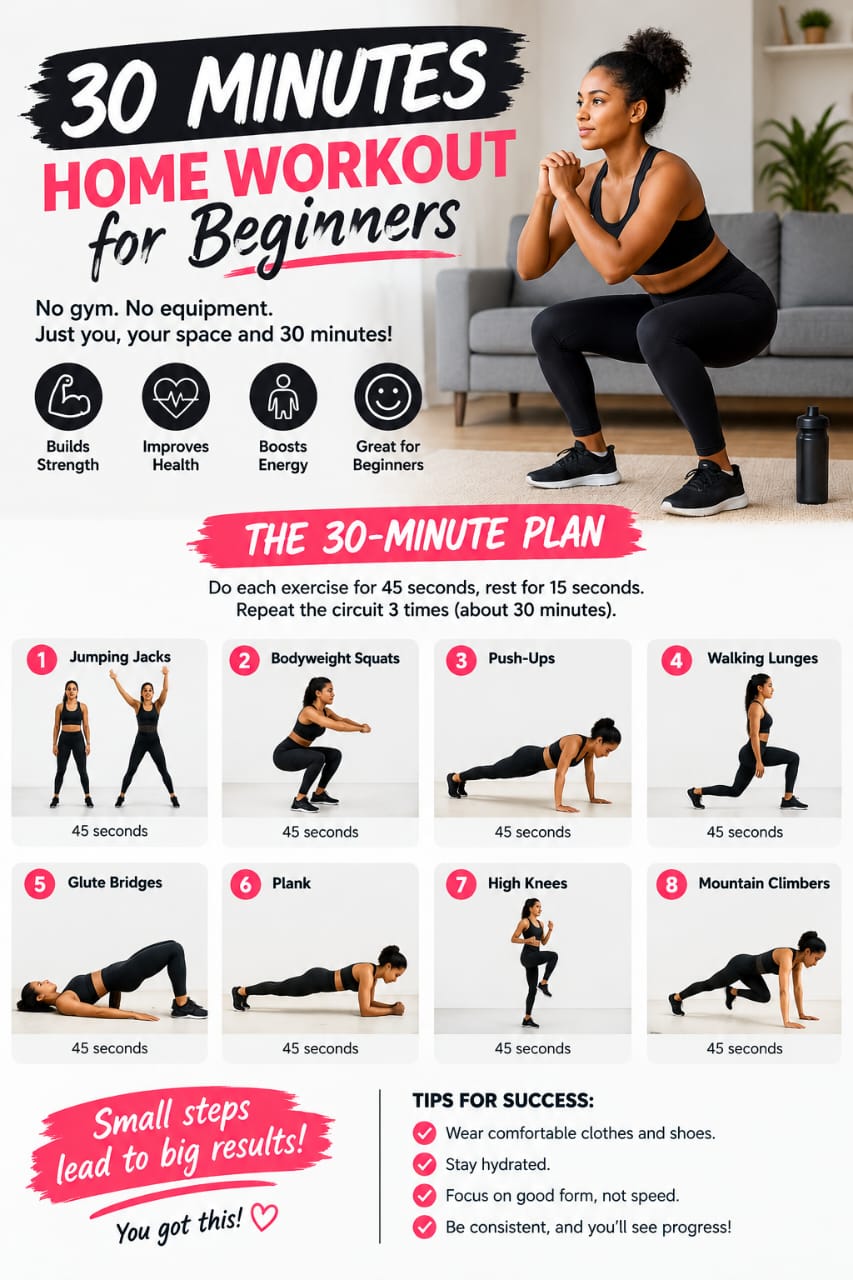
Tips for Staying Consistent
The most effective workout is one you can perform regularly.
Here are some strategies that can make consistency easier.
Schedule Your Workout
Choose a specific time of day for exercise.
For example, you could exercise before breakfast, during a lunch break, or after work.
Treat your workout like an important appointment.
Keep Your Equipment Ready
Place your workout clothes, shoes, and water bottle somewhere easy to access.
Reducing preparation time can make it easier to get started.
Start Small
If 30 minutes feels overwhelming, begin with 10 or 15 minutes.
Once exercise becomes part of your routine, gradually increase the duration.
Track Your Progress
Write down your workouts.
You can record the number of repetitions, exercise duration, or how difficult the session felt.
Seeing your progress can help keep you motivated.
Focus on Consistency Rather Than Perfection
Missing one workout does not mean you have failed.
Simply return to your routine at the next opportunity.
Your long-term consistency matters much more than one imperfect day.
Can You Lose Weight With a 30-Minute Home Workout?
A 30-minute workout can contribute to weight loss, but exercise is only one part of the equation.
Your overall energy intake, daily activity, sleep, stress, and eating habits can all influence body weight.
Instead of focusing only on the calories burned during one workout, think about creating sustainable habits.
A combination of regular exercise, nutritious foods, adequate sleep, and consistent daily movement can support your long-term goals.
If weight loss is your goal, avoid extreme diets or excessively restrictive eating plans. A gradual, sustainable approach is generally easier to maintain.
Can Beginners Build Muscle at Home?
Yes. Beginners can build strength and muscle using bodyweight exercises, especially when they are new to resistance training.
Exercises such as squats, lunges, push-ups, glute bridges, and planks can provide a useful starting point.
Over time, however, your body adapts to the same exercises. To continue progressing, you may eventually need to increase resistance, repetitions, training volume, or exercise difficulty.
You can introduce resistance bands, dumbbells, or other appropriate equipment as your fitness improves.
Safety Tips for Beginners
Before starting a new exercise program, consider your current health and fitness level.
Stop exercising if you experience severe pain, dizziness, fainting, unusual shortness of breath, or other concerning symptoms.
Muscle fatigue and mild exertion can be normal, but sharp or significant pain should not be ignored.
If you have an existing medical condition, recent injury, or concerns about whether exercise is appropriate for you, consider speaking with a qualified healthcare professional before beginning a new workout program.
Always use a stable surface and make sure your workout area is free of hazards.
Frequently Asked Questions
Is 30 minutes of exercise enough for beginners?
Yes. Thirty minutes can be enough for an effective beginner workout. The most important factors are consistency, exercise quality, appropriate intensity, and gradual progression.
Can I do this workout without equipment?
Yes. The routine is designed primarily around bodyweight exercises, so you can perform it without gym equipment.
A mat can make floor exercises more comfortable, but it is optional.
How many days a week should a beginner exercise?
Three workout sessions per week can be a reasonable starting point for many beginners. You can gradually increase your activity as your fitness and recovery improve.
Should I work out every day?
You do not need to perform this full workout every day. Rest and recovery are important, particularly when you are new to exercise.
You can use rest days for light activities such as walking, gentle stretching, or other comfortable movement.
Can I modify the exercises?
Absolutely. Beginners should modify exercises whenever necessary.
For example, you can perform wall push-ups instead of floor push-ups, chair-assisted squats instead of deep squats, and low-impact jumping jacks instead of traditional jumping jacks.
When will I see results?
Results vary from person to person.
Your progress depends on factors such as your starting fitness level, training consistency, nutrition, sleep, genetics, and overall activity level.
Instead of expecting immediate physical changes, look for improvements in strength, endurance, energy, mobility, and confidence.
Final Thoughts
A 30 minute home workout for beginners can be an excellent starting point if you want to become more active without going to a gym.
You do not need complicated equipment or advanced exercises. A simple combination of squats, push-up variations, lunges, glute bridges, core exercises, and low-impact cardio can provide a balanced full-body workout.
The most important thing is to begin at a level that feels manageable and gradually increase the challenge as you become stronger.
Remember that fitness is a journey. You do not need to be perfect, and you do not need to transform your body overnight. Start with 30 minutes, focus on proper form, listen to your body, and make consistency your primary goal.
If you can turn a simple home workout into a regular habit, you will have already taken one of the most important steps toward improving your fitness and overall health.