
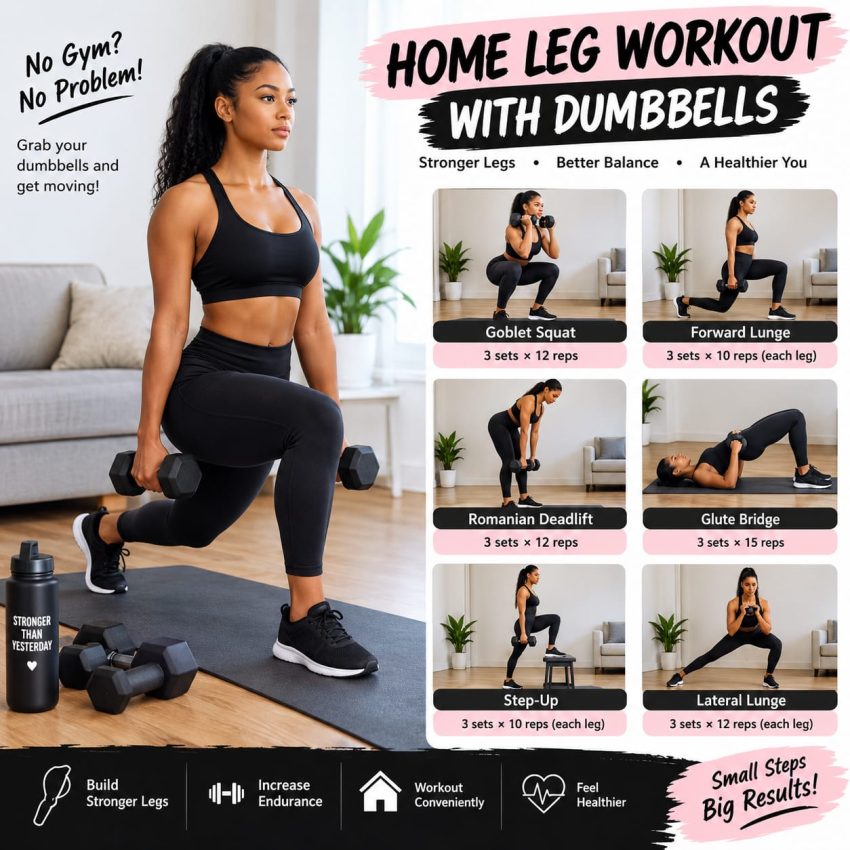
Home Leg Workout With Dumbbells: Build Stronger Legs at Home
You don’t need a fully equipped gym to build stronger, more muscular legs. With a pair of dumbbells, enough space to move comfortably, and a consistent training routine, you can perform an effective home leg workout with dumbbells that targets your quadriceps, hamstrings, glutes, and calves.
Dumbbells are especially useful for home workouts because they are versatile, easy to store, and allow you to progressively increase resistance as you become stronger. Whether your goal is to build muscle, improve lower-body strength, increase endurance, or simply become more active, dumbbell leg exercises can be an excellent addition to your fitness routine.
This guide explains how to structure an effective dumbbell leg workout at home, which exercises to include, how many sets and repetitions to perform, and how to make your workouts progressively more challenging.
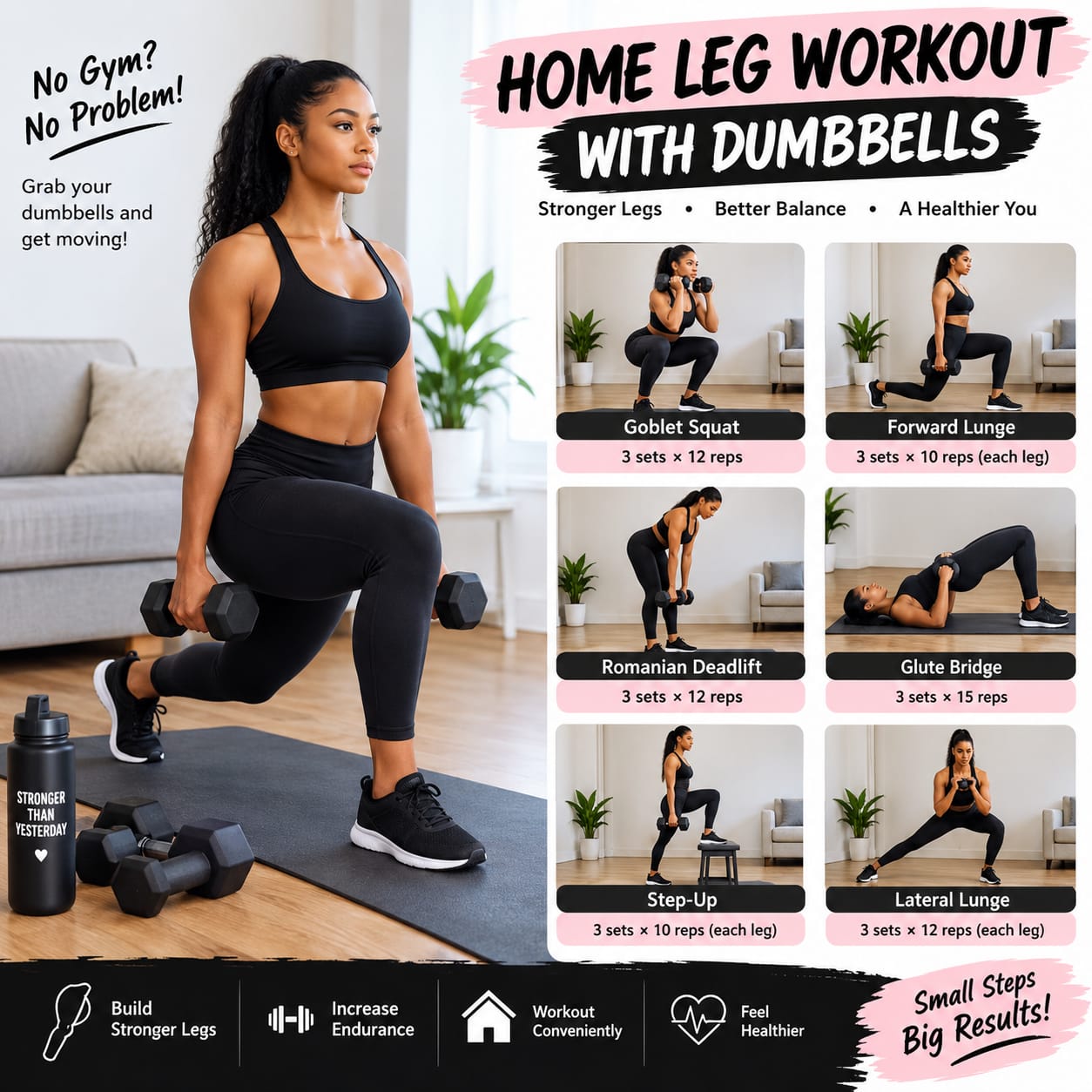
Why Do a Home Leg Workout With Dumbbells?
Your legs contain some of the largest and strongest muscles in your body. Training them regularly can improve your overall strength, balance, stability, athletic performance, and everyday movement.
A home leg workout with dumbbells also offers several practical benefits.
1. You Can Train Without a Gym
One of the biggest advantages of dumbbell workouts is convenience. You don’t have to drive to a gym, wait for equipment, or work around someone else’s schedule. You can complete your workout in your living room, garage, bedroom, or another suitable space.
All you need is enough room to perform exercises safely and a pair of dumbbells that provide an appropriate level of resistance.
2. Dumbbells Provide Adjustable Resistance
Bodyweight exercises are useful, but adding dumbbells gives your muscles additional resistance. This can make basic movements such as squats and lunges significantly more challenging.
As your strength improves, you can gradually increase the weight, repetitions, or number of sets.
3. Dumbbells Train Multiple Muscle Groups
A well-designed dumbbell leg workout can target your:
-
Quadriceps
-
Hamstrings
-
Glutes
-
Calves
-
Hip muscles
-
Core muscles
Many standing leg exercises also require your core to stabilize your body while you move.
4. They Are Beginner-Friendly
Dumbbells allow you to start with relatively light resistance and learn proper movement patterns before progressing to heavier weights. Beginners can focus on technique while experienced lifters can use heavier dumbbells for strength and muscle development.
How to Prepare for Your Home Leg Workout with dumbbells
Before starting your workout, spend approximately five to ten minutes warming up. A proper warm-up can prepare your muscles and joints for exercise and help you move more comfortably.
Your warm-up could include:
-
Marching in place
-
Bodyweight squats
-
Walking lunges
-
Hip circles
-
Leg swings
-
Glute bridges
-
Light jumping jacks
The goal isn’t to exhaust yourself before the workout. Instead, gradually raise your body temperature and prepare your lower body for resistance training.
After warming up, perform a few slow bodyweight repetitions of your first exercise. This gives you an opportunity to practice your technique before adding dumbbells.
The Best Home Leg Workout With Dumbbells
The following routine combines compound exercises and isolation-style movements to train the major muscles of your lower body.
For a balanced workout, perform the exercises in the order listed below.
1. Dumbbell Goblet Squat
The goblet squat is one of the best exercises to begin a home leg workout with dumbbells. It primarily works your quadriceps and glutes while also challenging your core.
How to perform it:
-
Stand with your feet approximately shoulder-width apart.
-
Hold one dumbbell vertically with both hands in front of your chest.
-
Keep your chest lifted and your shoulders relaxed.
-
Brace your core.
-
Bend your knees and push your hips backward.
-
Lower yourself into a comfortable squat position.
-
Keep your knees tracking in the same general direction as your toes.
-
Push through your feet to return to the starting position.
Aim for 3 sets of 8–12 repetitions.
Choose a weight that allows you to maintain good technique throughout every repetition.
2. Dumbbell Romanian Deadlift
Romanian deadlifts are excellent for strengthening the hamstrings and glutes. They also teach you how to properly hinge at the hips.
How to perform it:
-
Stand upright with a dumbbell in each hand.
-
Position your feet around hip-width apart.
-
Keep your knees slightly bent.
-
Brace your core and pull your shoulders gently back.
-
Push your hips backward while lowering the dumbbells along the front of your legs.
-
Keep your back neutral.
-
Lower the weights until you feel a comfortable stretch through your hamstrings.
-
Drive your hips forward to return to standing.
Perform 3 sets of 8–12 repetitions.
Don’t try to lower the dumbbells farther than your mobility allows. A controlled movement is more important than reaching the floor.
3. Dumbbell Reverse Lunge
Reverse lunges are a great unilateral exercise that trains one leg at a time. They target the quadriceps and glutes while also challenging your balance.
How to perform it:
-
Stand tall while holding a dumbbell in each hand.
-
Take a controlled step backward with one foot.
-
Bend both knees to lower your body.
-
Keep your front foot planted firmly.
-
Push through your front foot to return to the starting position.
-
Repeat on the opposite side.
Complete 3 sets of 8–10 repetitions per leg.
If you’re new to lunges, begin with lighter dumbbells or even bodyweight until you feel comfortable with the movement.
4. Dumbbell Bulgarian Split Squat
The Bulgarian split squat is more demanding than a standard squat because it places greater emphasis on one leg at a time.
You’ll need a stable chair, bench, or other elevated surface.
How to perform it:
-
Stand a short distance in front of a stable elevated surface.
-
Place one foot behind you on the surface.
-
Hold dumbbells at your sides.
-
Keep your torso controlled and your front foot planted.
-
Bend your front knee and lower your body.
-
Descend as far as comfortable while maintaining control.
-
Push through your front foot to return to the starting position.
-
Complete your repetitions before switching sides.
Perform 2–3 sets of 8–10 repetitions per leg.
Because this exercise can be challenging, start with lighter weights.
5. Dumbbell Sumo Squat
The sumo squat provides another way to train the lower body while placing more emphasis on the inner thighs and glutes.
How to perform it:
-
Stand with your feet wider than shoulder width.
-
Turn your toes slightly outward.
-
Hold one dumbbell with both hands in front of your body.
-
Brace your core.
-
Bend your knees and lower your hips.
-
Keep your chest reasonably upright.
-
Push through your feet to return to standing.
Perform 3 sets of 10–15 repetitions.
Avoid forcing your knees outward excessively. Your knees should move naturally in line with your feet.
6. Dumbbell Step-Up
If you have a sturdy step or exercise platform, dumbbell step-ups are an excellent addition to your home workout.
They work the quadriceps and glutes while also requiring balance and coordination.
How to perform it:
-
Stand facing a stable step or platform.
-
Hold a dumbbell in each hand.
-
Place one foot securely on the platform.
-
Push through that foot to step upward.
-
Bring your other foot onto the platform.
-
Step back down under control.
-
Repeat on the other side.
Complete 2–3 sets of 8–12 repetitions per leg.
Make sure the platform is stable and appropriate for exercise before adding weights.
7. Dumbbell Calf Raise
A complete home leg workout with dumbbells should not ignore your calves.
Calf raises are simple but effective for strengthening the muscles at the back of your lower legs.
How to perform it:
-
Stand upright with a dumbbell in each hand.
-
Keep your feet approximately hip-width apart.
-
Brace your core.
-
Slowly raise your heels from the floor.
-
Pause briefly at the top.
-
Lower your heels slowly.
Perform 3 sets of 12–20 repetitions.
For an additional challenge, you can perform calf raises with one leg at a time after developing sufficient balance and strength.
Complete Dumbbell Leg Workout Routine
If you want a simple routine to follow, use this structure:
| Exercise | Sets | Repetitions |
|---|---|---|
| Goblet Squat | 3 | 8–12 |
| Romanian Deadlift | 3 | 8–12 |
| Reverse Lunge | 3 | 8–10 each leg |
| Bulgarian Split Squat | 2–3 | 8–10 each leg |
| Sumo Squat | 3 | 10–15 |
| Step-Up | 2–3 | 8–12 each leg |
| Calf Raise | 3 | 12–20 |
You don’t necessarily need to perform every exercise during every workout. If you’re a beginner, start with four or five exercises and gradually increase your training volume as you adapt.
How Often Should You Train Your Legs?
For most people, training the legs two times per week can provide a practical balance between training stimulus and recovery.
For example:
-
Monday: Lower-body workout
-
Tuesday: Upper body or rest
-
Wednesday: Cardio or mobility
-
Thursday: Lower-body workout
-
Friday: Upper body or rest
-
Saturday: Light activity
-
Sunday: Rest
Your ideal schedule depends on your experience, training intensity, recovery, sleep, nutrition, and other physical activities.
Avoid training your legs hard every day. Muscles need time to recover and adapt after resistance training.
How Heavy Should Your Dumbbells Be?
The right dumbbell weight depends on your current strength and the exercise you’re performing.
A useful approach is to select a weight that makes the final few repetitions challenging while allowing you to maintain good form.
For example, if you’re performing 10 repetitions and could easily complete another 10, the weight may be too light for your current goal.
On the other hand, if you cannot complete the prescribed repetitions without losing proper technique, the weight may be too heavy.
Start conservatively, particularly when learning a new movement.
How to Make Your Dumbbell Leg Workout More Difficult
Progressive overload is an important part of strength and muscle development. Your muscles need a gradually increasing challenge over time.
You can progress your home leg workout with dumbbells in several ways.
Increase the Weight
Once you can comfortably perform the upper end of your repetition range with good form, consider moving to slightly heavier dumbbells.
Increase Repetitions
If heavier dumbbells aren’t available, gradually increasing repetitions can make an exercise more challenging.
For example, you might progress from 8 repetitions to 10 and eventually 12.
Increase Sets
Adding an additional set can increase your overall training volume.
However, more sets aren’t automatically better. Increase volume gradually and pay attention to recovery.
Slow Down Your Repetitions
Instead of rushing through each repetition, use controlled movements.
For example, take two or three seconds to lower yourself during a squat and then stand up with control.
Use Single-Leg Exercises
Exercises such as reverse lunges, Bulgarian split squats, and step-ups increase the challenge by making each leg work more independently.
Common Mistakes During Home Dumbbell Leg Workouts
Even simple exercises can become less effective or unnecessarily risky when performed with poor technique.
Using Too Much Weight
One of the most common mistakes is selecting dumbbells that are too heavy.
Heavy weights aren’t useful if you have to sacrifice your technique to lift them.
Start with a manageable load and focus on controlled movement.
Performing Repetitions Too Quickly
Fast repetitions can reduce control and make it harder to maintain proper positioning.
Instead, use a deliberate pace and focus on the muscles you’re training.
Ignoring the Hamstrings and Glutes
Some people focus almost entirely on squats and other quad-dominant exercises.
A balanced leg routine should also include hip-hinge movements such as Romanian deadlifts to train the posterior chain.
Neglecting Single-Leg Training
Exercises performed one leg at a time can help challenge balance and coordination while ensuring each leg does its share of the work.
Skipping the Warm-Up
You don’t need an extremely long warm-up, but spending a few minutes preparing your body can help you transition into your workout.
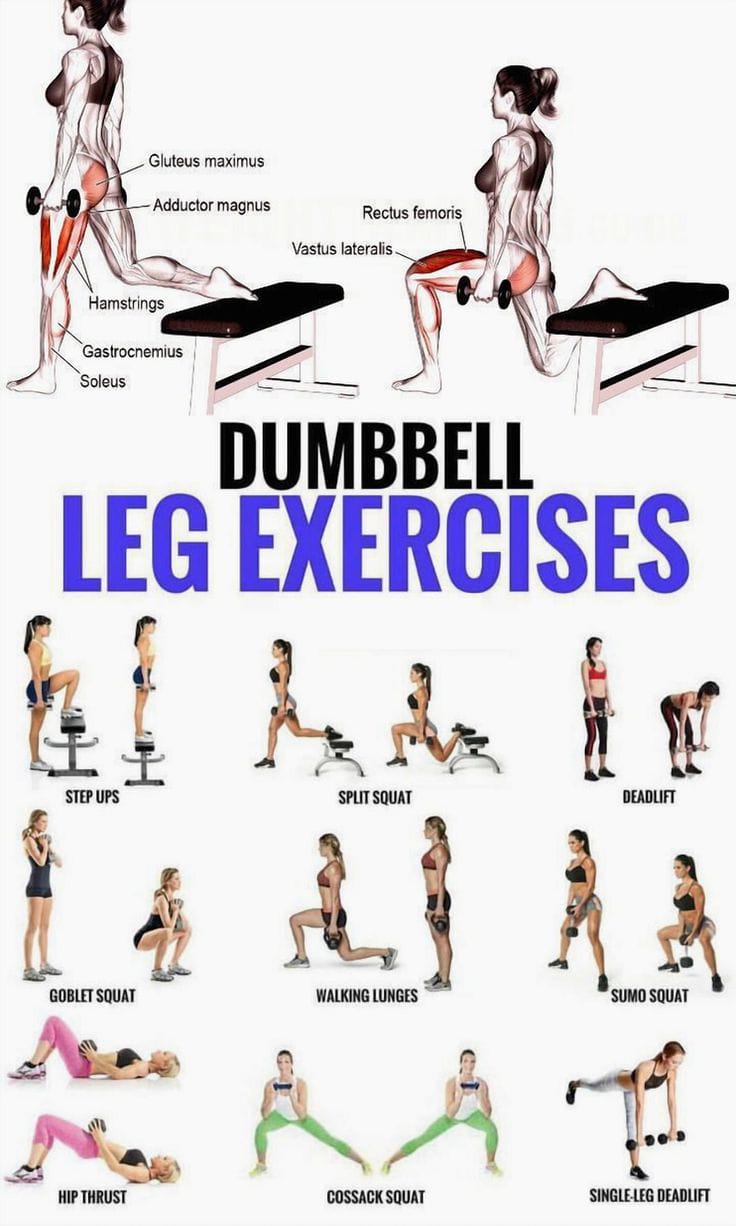
Dumbbell Leg Workout for Beginners
If you’re new to resistance training, you don’t need to begin with seven exercises.
Try this beginner-friendly routine:
-
Goblet squat: 3 × 8–10
-
Romanian deadlift: 3 × 8–10
-
Reverse lunge: 2 × 8 each leg
-
Glute bridge: 3 × 12–15
-
Calf raise: 2 × 15–20
Rest for approximately 60–120 seconds between challenging sets.
Focus on learning the movement patterns before worrying about lifting heavy weights.
Intermediate Home Leg Workout With Dumbbells
Once you’ve developed a solid foundation, you can increase the difficulty.
Try:
-
Goblet squat: 4 × 8–12
-
Romanian deadlift: 4 × 8–12
-
Bulgarian split squat: 3 × 8–10 each leg
-
Dumbbell reverse lunge: 3 × 10 each leg
-
Sumo squat: 3 × 12–15
-
Calf raise: 4 × 15–20
You can also incorporate pauses, slower eccentric movements, or heavier dumbbells as appropriate.
How Long Should a Home Leg Workout Take?
A typical dumbbell leg workout can take approximately 30–60 minutes, depending on the number of exercises, sets, rest periods, and your training experience.
A shorter workout can still be effective.
If you only have 20–30 minutes, focus on compound movements such as:
-
Goblet squats
-
Romanian deadlifts
-
Reverse lunges
-
Calf raises
Perform these exercises with good technique and appropriate intensity rather than trying to squeeze too many movements into a short session.
Rest Between Sets
Rest periods depend on the exercise and your goals.
For demanding compound exercises, you may need around 1–3 minutes of rest between sets. For lighter isolation movements, shorter rest periods may be sufficient.
Don’t feel pressured to start another set before you’ve recovered enough to perform it safely and effectively.
If your breathing is still extremely elevated or your muscles are too fatigued to maintain proper technique, take additional recovery time.
Nutrition and Recovery
Exercise is only one part of building stronger legs. Recovery and nutrition also matter.
Make sure you’re eating enough nutritious food to support your activity level. Include protein-rich foods, carbohydrates, healthy fats, fruits, vegetables, and adequate fluids.
Sleep is also important. Your body needs recovery time between challenging workouts.
If your legs remain extremely sore or fatigued for several days after every workout, consider reducing your training volume or intensity.
Can You Build Leg Muscle With Dumbbells at Home?
Yes. Dumbbells can provide enough resistance to stimulate your leg muscles, particularly when you progressively increase the training challenge.
However, your results depend on several factors, including:
-
Training consistency
-
Exercise selection
-
Progressive overload
-
Nutrition
-
Recovery
-
Genetics
-
Training experience
You don’t need dozens of machines to train your legs effectively. A pair of adjustable or fixed dumbbells can support a wide variety of lower-body exercises.
How to Get Better Results From Your Home Leg Workout
Consistency is more important than constantly changing your routine.
Choose several effective exercises and practice them regularly. Track your weights and repetitions so you can see whether you’re progressing.
For example, you might record:
Goblet squat
Week 1: 20 kg × 8
Week 2: 20 kg × 10
Week 3: 20 kg × 12
Week 4: 22 kg × 8
This simple form of tracking helps you identify progress over time.
You can apply the same approach to Romanian deadlifts, lunges, split squats, and other exercises.
Safety Tips for Dumbbell Leg Training at Home
Before starting your workout, make sure you have enough space to move safely.
Keep your workout area free of objects that could cause you to trip. Check that your dumbbells are in good condition and that any bench, chair, or step you’re using is stable.
During lunges. However, having a pair gives you more exercise options, particularly for Romanian deadlifts, farmer-style movements, and exercises when you consistently perform resistance training with sufficient effort and progressively increase the challenge. Nutrition and goal, performing your resistance workout before demanding cardio is generally more practical. You can also perform cardio on separate days occur relatively quickly when beginners start resistance training, while visible muscle changes generally require consistent training over a longer periodbells can provide enough versatility to create an effective lower-body training program at home. Combine consistent resistance training with adequate nutrition, sleep, and recovery, and you can each exercise:
-
Keep your movements controlled.
-
Use a weight appropriate for your ability.
-
Avoid sacrificing technique to complete repetitions.
-
Stop if you experience sharp or unusual pain.
-
Give your muscles adequate recovery time.
-
Increase training difficulty gradually.
If you have an injury, medical condition, or significant physical limitation, consider speaking with a qualified healthcare professional before beginning a new exercise program.
Frequently Asked Questions
Is a home leg workout with dumbbells effective?
Yes. Dumbbell exercises can effectively train the quadriceps, hamstrings, glutes, and calves. The key is using appropriate resistance, maintaining good technique, and progressively increasing the training challenge.
How many dumbbells do I need for a leg workout?
A single dumbbell can be enough for exercises such as goblet squats and certain lunges. However, having a pair gives you more exercise options, particularly for Romanian deadlifts, farmer-style movements, and exercises where you hold one weight in each hand.
Can I train legs at home without a squat rack?
Yes. You can perform many effective leg exercises without a squat rack. Goblet squats, lunges, split squats, Romanian deadlifts, step-ups, and calf raises can all be performed with dumbbells.
How many leg exercises should I do in one workout?
For most people, four to seven exercises are enough for a productive lower-body session. Beginners can start with fewer exercises and increase their training volume gradually.
Can dumbbells make my legs bigger?
Dumbbells can contribute to muscle growth when you consistently perform resistance training with sufficient effort and progressively increase the challenge. Nutrition and recovery also play important roles in muscle development.
Should I do cardio before or after leg training?
If building strength or muscle is your primary goal, performing your resistance workout before demanding cardio is generally more practical. You can also perform cardio on separate days depending on your schedule.
How quickly will I see results?
Results vary from person to person. Strength improvements can occur relatively quickly when beginners start resistance training, while visible muscle changes generally require consistent training over a longer period.
The most important factor is maintaining a routine that you can follow consistently.
Final Thoughts
A home leg workout with dumbbells can be a simple and effective way to strengthen your lower body without relying on a commercial gym. Exercises such as goblet squats, Romanian deadlifts, reverse lunges, Bulgarian split squats, step-ups, sumo squats, and calf raises allow you to target the major muscles of your legs using relatively simple equipment.
The key is not to make every workout complicated. Start with manageable weights, learn proper technique, and gradually increase the challenge as your strength improves.
Whether you’re a complete beginner or an experienced lifter, dumbbells can provide enough versatility to create an effective lower-body training program at home. Combine consistent resistance training with adequate nutrition, sleep, and recovery, and you can build stronger, more capable legs without needing a large collection of gym machines.